
Introduction
That half-empty office building or dark strip retail center on your books isn't automatically a housing opportunity. It might be a genuine residential conversion candidate, or it might be a costly dead end, depending on zoning, physical bones, market demand, and the numbers.
Commercial-to-residential conversion is legal in many US jurisdictions. But no federal or state rule automatically clears a commercial building for housing. Local land-use rules, building codes, utility capacity, and the structure's actual ability to support safe, livable units all determine whether the project works.
This guide walks through how to screen a property, navigate approvals, budget the full investment, and decide whether converting, selling to a developer, or pursuing a mixed-use path makes the most sense for your asset.
Key Takeaways
- Legal residential use rights and fire/life-safety code compliance are non-negotiable.
- Zoning approval starts the process; layout, light, and utilities decide true feasibility.
- Compare conversion costs against selling to a developer, a joint venture, or ground-up redevelopment.
- Confirm incentives and tax treatment with licensed advisors before assuming eligibility.
Can Commercial Property Be Converted to Residential Use?
Yes, in many cases, but there's no blanket rule that clears the path. Whether your building qualifies depends entirely on local zoning and how well the structure can be adapted.
Four distinct approval paths exist, and they're not interchangeable:
- Permitted or by-right use — residential use is already allowed under current zoning; you still need building permits and occupancy approval.
- Conditional or special use — permission is granted subject to conditions. The American Planning Association describes this as "conditional use," "special permit," or "special exception," depending on the jurisdiction.
- Rezoning — a formal change to the zoning designation itself, distinct from a building-code change of occupancy.
- Mixed-use classification — allows residential and commercial uses to coexist on one site, but each component use still needs its own approval.
Not All Building Types Convert Equally
Zoning approval is only half the test—the building still has to work as housing. Offices, hotels, warehouses, retail centers, and schools all show up in the national conversion pipeline, but the physical challenges differ sharply:
- Offices — Gensler screened more than 1,300 office buildings across North America and found only 25% suitable for residential conversion, largely because deep floor plates block natural light to interior units.
- Hotels — convert more easily because guest rooms already resemble small dwelling units; a Bisnow analysis of 2023 completed apartment conversions found hotels made up 36% of the total.
- Warehouses — accounted for 9% of those same completed conversions.
Location matters just as much as building type. Proximity to jobs, transit, schools, and services affects both your odds of approval and whether renters or buyers will actually want to live there.

What to Evaluate Before Converting a Commercial Property
Zoning approval means nothing if the building itself can't support housing. Before committing capital, run the property through three lenses.
Physical Suitability
- Floor-plate depth and daylight access — deep interior space without windows is hard to legally use as bedrooms.
- Ceiling and floor-to-floor heights — new mechanical, plumbing, and fire systems eat into clear height.
- Structural grid, elevators, and plumbing risers — these are expensive and sometimes impossible to relocate.
- HVAC and electrical capacity — commercial systems rarely match residential load requirements without upgrades.
Technical and Regulatory Risk
These issues can derail a project that looked promising on paper:
- Environmental contamination
- Flood exposure
- Structural condition
- Fire separation
- Accessibility compliance
HUD's 2024 guidance specifically notes that a commercial-to-residential change does not qualify for certain categorical exclusions in federally covered environmental reviews. A full environmental assessment may be required even when it wouldn't be for a like-for-like renovation.
Market and Highest-and-Best-Use Fit
Before assuming conversion is the answer, test it against alternatives. What unit mix, rents, or sale prices could the market realistically absorb? Is there competing housing already in the pipeline nearby?
This is where a structured highest-and-best-use analysis earns its keep. Greenfield Group's engineer site analyses, for example, map environmental and drainage constraints alongside zoning and utility capacity. That gives owners a clearer picture before they spend money on architectural plans that may never get approved.
The Commercial-to-Residential Conversion Process
Converting a commercial building follows a sequence, though timelines vary widely by jurisdiction.
- Run a preliminary feasibility study. Review current zoning, permitted density, overlays, historical restrictions, existing leases, title issues, and utility availability.
- Assemble your professional team. A land-use attorney, architect, structural engineer, environmental consultant, code consultant, contractor, and lender each own a piece of the approval puzzle.
- Map the entitlement path. This might mean a simple zoning verification, or it might require site-plan approval, a conditional-use hearing, a variance, or full rezoning.
- Develop a concept plan that shows unit count, unit mix, parking, open space, fire protection, and accessibility features before permits are pulled.
- Pull permits and complete construction. Building, demolition, plumbing, electrical, and fire permits are typically separate applications, each with its own inspection sequence.
- Secure the certificate of occupancy. Under the 2021 International Building Code model provision, a building cannot legally be occupied for its new use until the certificate is issued. No shortcuts.
Don't rely on generic approval timelines you find online. Review periods, public hearing schedules, appeals, and utility upgrade lead times vary by city and county, and they can add months or years to a project that looked fast on a spreadsheet.
Entitlement is usually where those delays stack up. Greenfield Group's entitlement review catches that risk early, because zoning language that reads as "mixed-use eligible" doesn't always translate into a workable residential approval without additional review.

Is the Conversion Financially Viable?
This is where most conversion projects actually get decided. A building can be zoning-eligible and structurally sound and still lose money if the numbers don't pencil.
Build the Full Budget
A realistic conversion budget covers far more than construction:
- Acquisition or opportunity cost
- Due diligence, design, and entitlement fees
- Demolition, structural, plumbing, electrical, HVAC, and fire-protection work
- Elevators, parking, and accessibility upgrades
- Financing costs, insurance, taxes, and carrying costs through construction
- Marketing and a contingency reserve
Construction costs vary widely by scope. CBRE's 2023 research put office-to-multifamily conversion costs at $100 to $500-plus per square foot, depending on the extent of structural and systems work required. That's a wide range, not a quote, so price your specific scope before comparing conversion against other exit strategies.
Weigh Delays Against Carrying Costs
Every month of approval uncertainty adds interest expense, insurance, taxes, and lost income potential. If existing tenants remain under lease during the entitlement phase, that further complicates the timeline and cash flow.
Research Incentives, Don't Assume Them
Historic rehabilitation tax credits, affordable-housing incentives, Opportunity Zone investment, and C-PACE financing can change project economics. But eligibility depends on the property, the owner, the location, and program-specific rules that shift over time. Confirm applicability with a tax adviser before building these into your pro forma.
Three Paths Forward
- Convert directly — you control the outcome but carry all the execution risk.
- Sell to a developer — transfers construction and lease-up risk, often for a faster, cleaner exit.
- Structure a joint venture — shares upside and risk with a partner who brings capital or construction expertise.
Greenfield Group works this exact decision point with owners of older Florida commercial buildings. Rather than pricing a property off existing rental income alone, the team evaluates zoning, entitlements, utilities, and highest-and-best use.
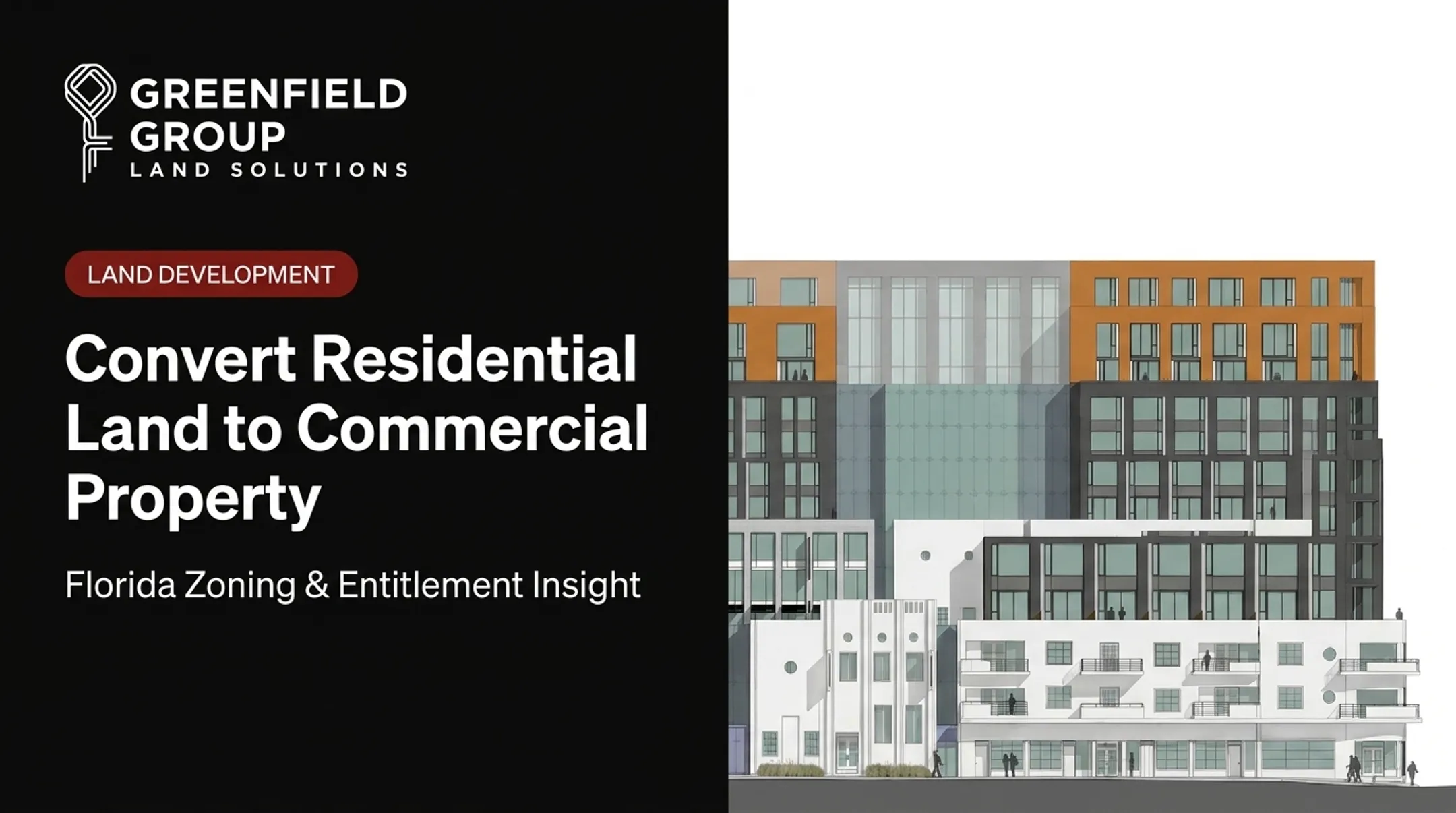
They prepare preliminary planning materials, including a scaled site plan and architect's concept, so buyers can visualize what the site could become. The Avalon—a mixed-use concept pairing a preserved historic facade with contemporary multi-story construction—shows how that analysis becomes a marketable development package.

A note on advice: Legal, tax, engineering, construction, and investment decisions here require input from appropriately licensed professionals. This article is a framework for asking the right questions, not a substitute for that advice.
Frequently Asked Questions
Can a commercial property be converted to a residential property?
In many cases, yes, but only when local zoning permits or approves residential use and the building can meet residential building, fire, accessibility, and health codes. Neither factor alone is sufficient.
Do planning rules or time limits apply when converting a commercial property to a residential property?
Yes. Deadlines, occupancy conditions, permit requirements, and incentive-program timelines all vary by jurisdiction. Confirm specifics with your local planning authority before assuming a timeline.
What are the tax implications of converting a commercial property to residential?
Conversion can affect property classification, assessment, depreciation schedules, transfer taxes, and capital gains treatment. Speak with a tax professional early, since rules vary by state and property type.
Can you live in a converted warehouse?
Only after it clears required land-use approvals, construction work, inspections, and a certificate of occupancy. An appealing industrial look doesn't make a space legally habitable.
What do you call a building that has both commercial and residential uses?
It's called a mixed-use building or mixed-use development. The exact zoning classification and permitted combination of uses still depends on local rules.