
Introduction
Commercial property can generate rental income, give you control over a tangible asset, and build long-term wealth. But buying a building and collecting rent checks isn't the whole story.
Returns depend on property type, location, tenant quality, lease structure, financing, and execution. CBRE's Q4 2025 industrial report put national industrial vacancy at just 6.7%, while other property types are moving in entirely different directions.
Many investors underestimate the gap between an attractive listing and a profitable closing. This guide covers whether commercial property fits your goals, how to choose a route, run the numbers, complete due diligence, arrange financing, and avoid mistakes that sink promising deals.
Key Takeaways
- Direct ownership, redevelopment, partnerships, REITs, private funds, and crowdfunding differ on capital, liquidity, and control.
- Screen every deal on income quality, expenses, financing, tenant concentration, condition, and highest-and-best-use.
- Longer leases steady income, but vacancy, tenant improvements, and refinancing risk can erase returns fast.
- Never rely on asking price or projected rent alone: verify leases, title, and condition first.
How to Invest in Commercial Property
There's no single "right" way to invest in commercial real estate. The right route depends on your capital, timeline, and appetite for hands-on work. Here's the process, step by step.
Step 1: Define Your Investment Strategy and Budget
Before you look at a single listing, decide what you're actually trying to achieve.
- Set your objective: stable income, long-term appreciation, active value creation, redevelopment, owner occupancy, or portfolio diversification.
- Know your numbers: available equity, acceptable debt exposure, liquidity reserves, target holding period, and how much vacancy or income decline you could absorb without stress.
- Assess your bandwidth: do you have time and expertise to manage tenants and buildings, or do you need a lower-involvement route?
Direct ownership gives you full control and full responsibility. Publicly traded REITs, private funds, syndications, and crowdfunding platforms trade some of that control for liquidity or lower entry costs, though eligibility rules differ.
Under SEC guidance, Regulation D offerings that use general solicitation generally require investors to be verified accredited investors. That usually means a net worth over $1 million (excluding your primary residence) or qualifying income above $200,000 individually in each of the prior two years.
Step 2: Choose a Market and Property Type
Not every commercial sector behaves the same way right now. Office, retail, industrial, multifamily, and hospitality each carry different tenant concentration, capital needs, and market exposure.
Research before you commit:
- Population and employment trends, business formation, and infrastructure investment
- Competing supply under construction versus current absorption
- Rent levels and vacancy patterns from current, authoritative sources
- Zoning and permitted density if redevelopment is part of the plan
Also classify the opportunity honestly:
| Classification | What it means |
|---|---|
| Core | Stabilized, occupied, minimal development risk |
| Core-plus | Core asset with moderate upside or condition issues |
| Value-add | Existing cash flow with planned gains from leasing or renovation |
| Opportunistic | Distressed assets or ground-up development, higher risk and return |
A value-add office building and a core industrial warehouse require completely different skill sets and reserves. Match the classification to your actual capacity, not your ambition.
Step 3: Source and Screen Opportunities
Once you've identified a target market and property type, request the documents that reveal what you're really buying:
- Rent roll, operating statements, and executed leases with amendments
- Tax records, utility information, and service contracts
- Capital expenditure history and environmental records
- Any existing surveys, site plans, or entitlement documents
Screen for income quality, upcoming lease expirations, tenant credit, deferred maintenance, insurance costs, parking and access, and whether surrounding land use is shifting.
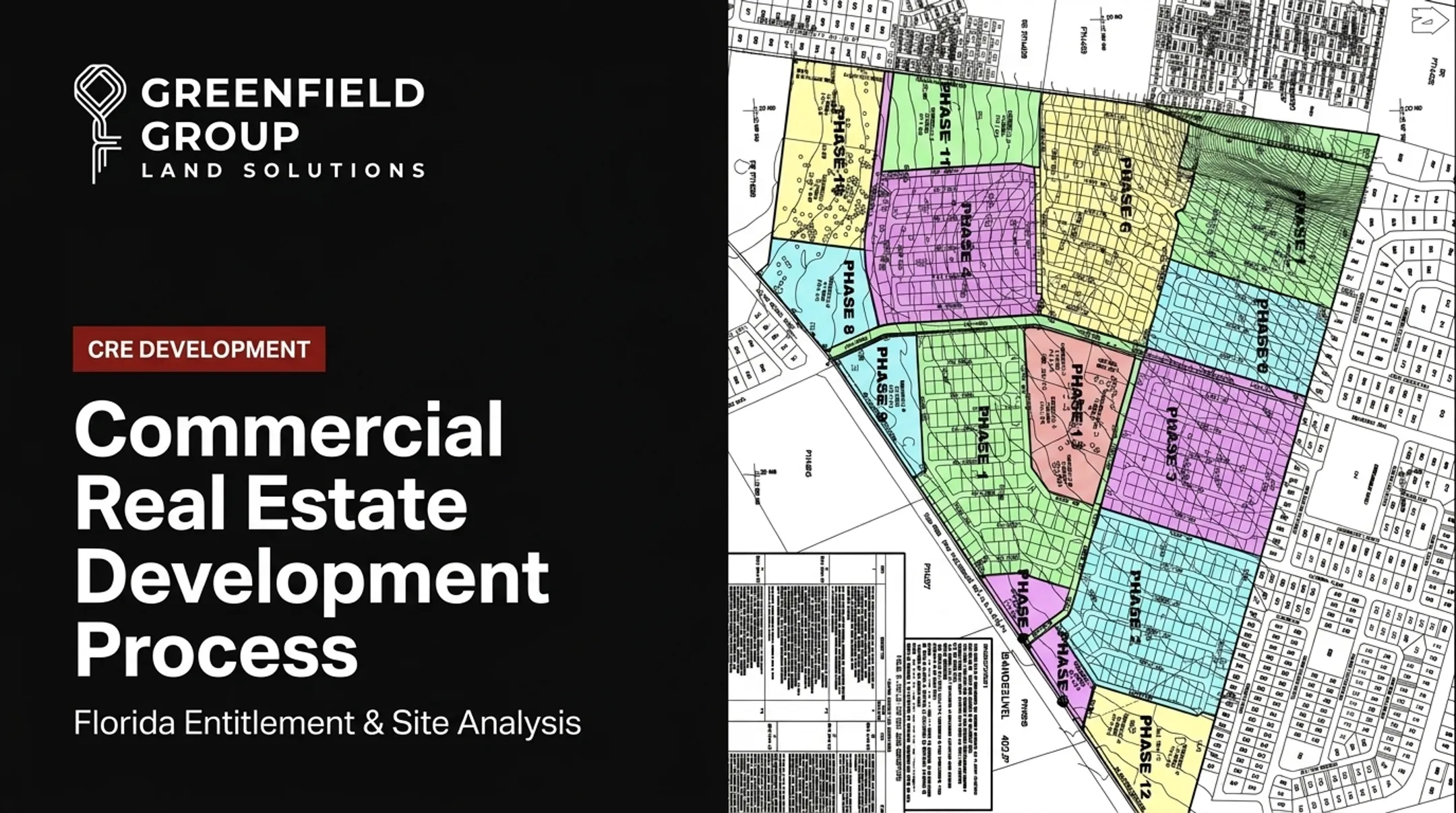
For land or underperforming buildings, dig deeper into zoning, permitted uses, density, utility capacity, setbacks, and environmental constraints. Sometimes a tired retail center or half-empty office building is worth more redeveloped than continued as-is. This is where developer-level underwriting matters.
Greenfield Group, a Florida-based development-property practice, reviews zoning, entitlements, utilities, highest-and-best use, and site conditions the way a developer would before deciding whether value lies in operation or redevelopment. That background comes from more than 20 years entitling and delivering Florida development projects, not from acting as a lender or investment adviser.
Step 4: Underwrite, Complete Due Diligence, Finance, and Close
Run the numbers before you fall in love with the property.
- Calculate the fundamentals: net operating income (NOI), effective gross income, operating expenses, capital expenditures, debt service, loan-to-value, and debt-service coverage ratio.
- Stress-test the deal for higher interest rates, slower lease-up, tenant loss, rent reductions, construction overruns, and a lower resale value than projected.
- Assemble your team: commercial broker, lender, real estate attorney, accountant, property manager, inspector, environmental consultant, surveyor, and zoning professional as needed.
- Negotiate contingencies into your letter of intent and purchase agreement covering inspection, financing, title, environmental, zoning, and lease document review before you remove them.

Lending conditions shift, so verify current terms rather than assuming last year's rates. CBRE's Q1 2025 lending report found average closed-loan LTV at 62.2% and agency fixed-rate pricing near 5.8% for 7-10-year multifamily loans. Those figures are useful context, not a guaranteed quote for your deal.
When Commercial Property Investing Makes Sense and What You Need First
Commercial property suits investors who want control over a physical asset, recurring income, and the potential to create value through leasing, renovation, or redevelopment. It is not automatically passive, and it's not right for every budget.
Business Infrastructure Before You Buy
Before you buy anything, have the infrastructure in place:
- A proper investment entity and accounting system
- Established lender or financing relationships
- A property-management plan and insurance review
- Document storage, reporting processes, and adequate cash reserves
Underwriting Documents You Need
You'll need reliable documents to underwrite accurately:
- Financial statements and a complete rent roll
- Executed leases and amendments
- Property tax and insurance records
- Surveys, title information, and zoning confirmation
- Environmental reports and realistic market rent evidence Missing any of these creates blind spots that surface after closing, not before.
Compliance and Professional Review
Have qualified professionals verify the rules that affect the deal, including:
- Zoning, building codes, and accessibility requirements
- Environmental rules and licensing
- Tax treatment and loan covenants
- Securities rules if you pool investor capital Do not treat listing-sheet summaries as final answers. If those pieces are not in place, indirect investing or partnering is often the better fit. Choose that path when you lack sufficient capital, time, operating expertise, or tolerance for illiquidity and tenant management. A REIT, fund, or joint venture can still give you exposure without full operating burden. If you own surplus or underperforming commercial property and are unsure whether it is worth more operating or redeveloping, Greenfield Group can evaluate development potential and market hard-to-value assets to developers seeking redevelopment sites, subject to suitability and engagement terms.

Key Parameters That Affect Results When Investing in Commercial Property
Commercial real estate performance depends on assumptions you can control and conditions you can't. Define each metric plainly before you rely on it.
| Parameter | Why It Matters | Impact on Performance |
|---|---|---|
| Income quality and lease structure | Rent collection depends on tenant credit, lease duration, renewal options, escalations, and reimbursement terms | One large tenant, near-term expirations, or below-market rents can swing cash flow and valuation significantly |
| NOI and expense accuracy | Because NOI excludes financing, capital expenditures, and leasing commissions, expense gaps flow straight into price and returns | Overstated NOI inflates purchase price and projected returns when expenses aren't tied back to bank statements and invoices |
| Location and highest-and-best use | Access, employment growth, competing supply, and zoning drive both tenant demand and redevelopment value | The best use may differ from current use, but upside needs feasibility work and approvals, not a conceptual site plan |
| Financing and exit assumptions | Interest rate, amortization, recourse, covenants, and refinancing exposure all shape returns | Rate resets, tighter covenants, or a weaker exit cap can erase returns modeled on today's terms |
| Physical condition and capital needs | Roofs, mechanical systems, structure, and tenant improvements affect total cost of ownership | Deferred maintenance can trigger vacancy, expense growth, or a capital call larger than your original underwriting |
Support market-sensitive claims with current data rather than assumptions carried over from a prior cycle. A cap rate that made sense two years ago may not reflect today's lending environment.
Common Mistakes and Troubleshooting Issues While Investing in Commercial Property
Most deal problems trace back to incomplete information, treating projections as verified facts, or skipping downside planning.
| Mistake | Likely Cause | What to Check or Adjust |
|---|---|---|
| Skipping preparation or checks | Moving forward on an attractive price or headline cap rate without confirming leases, title, zoning, or physical condition | Pause the deal, build a written due-diligence checklist, and assign each item to a qualified professional |
| Inaccurate income or expense assumptions | Treating temporary income as recurring, excluding vacancy, or trusting unverified operating statements | Reconcile the rent roll against leases and payment records, then rerun underwriting with conservative numbers |
| Financing no longer works | Rate changes, lender valuation gaps, weak debt-service coverage, or an exit tied to one refinancing event | Get updated lender terms, stress-test debt service, and identify a backup disposition path |
| Development or leasing stalls | Unclear entitlements, utility limits, construction-cost increases, or demand that doesn't support the proposed use | Get written agency feedback, update the budget and schedule, and decide whether to redesign, partner, or exit |
Downside planning also means stress-testing tenant concentration. A single anchor closure can erase value quickly: Trepp documented a $51.1 million realized loss on a Texas mall loan after the anchor closed and the collateral’s appraised value fell sharply.

Legal, tax, lending, environmental, construction, and securities questions require advice from qualified professionals. Nothing in this article should be treated as personalized investment advice.
Conclusion
Commercial property investing works best when the asset, market, financing, and your own objectives line up. Build that alignment with verified financials, realistic downside analysis, and thorough due diligence—not a projected return on a marketing flyer.
Choose the path that fits your capital and capacity: direct ownership, redevelopment, partnership, or an indirect vehicle like a REIT or fund. Then assess the specific opportunity in front of you before committing capital, not after.
Frequently Asked Questions
How much money do I need to invest to make $10,000 a month?
There's no fixed number; it depends on the property's cash flow, financing terms, expenses, taxes, and vacancy. Underwrite a specific opportunity rather than working backward from a target income.
Is $5,000 enough to invest in real estate?
Not for direct commercial ownership, but it may be enough for shares in a publicly traded REIT or certain crowdfunding offerings. Eligibility, fees, liquidity, and risk vary by vehicle.
Is this a good time to invest in commercial real estate?
Timing depends on property fundamentals, financing terms, local demand, and your holding period, not a general market slogan. Review current sector-specific data before deciding.
What is the best type of commercial property to buy?
It depends on your capital, expertise, and risk tolerance. Industrial tends to run leaner operationally; retail and office carry more tenant-management complexity; multifamily offers diversified income across many units.
What is the most profitable property investment?
Profitability comes from purchase price, income quality, expenses, financing, and execution, not the property category alone. A well-run stable asset can outperform a poorly executed value-add deal.
What is the 1% rule in commercial real estate?
The 1% rule (monthly rent equal to 1% of price) is a rough residential screening tool, not a commercial standard. Commercial deals require NOI, cap rate, DSCR, and full expense analysis instead.